Table of Contents
The E-Commerce Problem Nobody Talks About
India has over 63 million micro, small and medium enterprises. They sell groceries, clothes, handicrafts, electronics, food, and services across every corner of the country. They employ more Indians than any other sector. And yet, when e-commerce arrived in India, it largely bypassed them.
The reason is structural. Amazon, Flipkart, Swiggy, and Zomato are closed platforms. To sell on Amazon, you must list on Amazon, comply with Amazon's rules, pay Amazon's commissions — which range from 25% to 30% of every transaction — and accept that Amazon can change the terms at any time. Your customer relationship belongs to Amazon, not to you. Your data belongs to Amazon. Your discoverability depends entirely on Amazon's algorithm.
Of India's more than 12 million sellers who earn their livelihood by selling or reselling products and services, only 15,000 — just 0.125% of the total — had enabled e-commerce. The platform model was not democratising commerce. It was concentrating it.
ONDC is India's answer to this problem.
What ONDC Actually Is
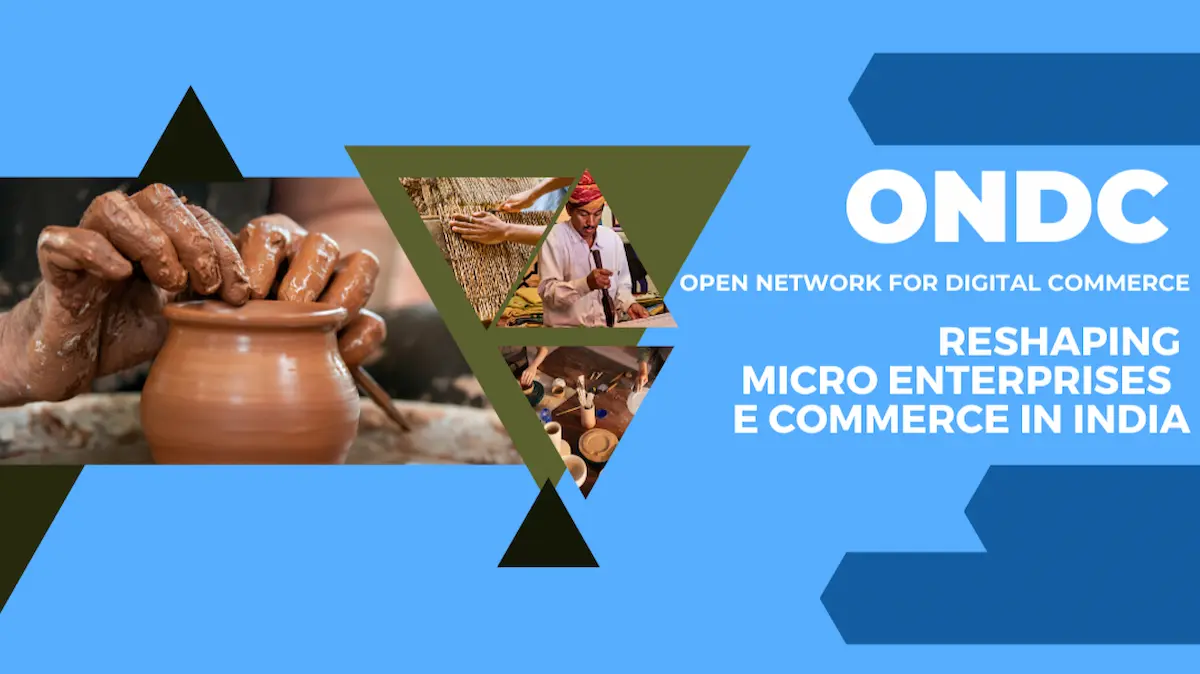
The Open Network for Digital Commerce is not a shopping app. Like UPI in payments, ONDC is an infrastructure layer — an open protocol that allows any seller app, any buyer app, and any logistics provider to interoperate on a single network.
The best analogy is email. When you send an email from Gmail to a Yahoo address, it works — even though Gmail and Yahoo are competing companies — because both use the same underlying protocol (SMTP). ONDC applies this logic to commerce. A seller listed on one app can be discovered and purchased by a buyer on a completely different app. The seller keeps their customer relationship. No single platform controls the transaction.
Launched in April 2022, ONDC is an initiative of the Department for Promotion of Industry and Internal Trade (DPIIT) under the Ministry of Commerce and Industry, incorporated as a Section 8 company with an authorised capital of Rs 500 crore. Its founding members include the Quality Council of India and Protean eGov Technologies.
How ONDC Works in Practice
Imagine you open Paytm to order lunch. You search for a biryani restaurant. Behind the scenes, Paytm — acting as a buyer app on ONDC — queries every seller registered on the ONDC network, not just those who have paid to list on Paytm. The results include restaurants listed on Magicpin, on local food apps, on the restaurant's own ONDC-connected portal — all surfaced together in your Paytm interface.
You place an order. The payment flows through ONDC's payment rails. The delivery is assigned to whichever logistics provider — Dunzo, Shadowfax, or a local courier — is available and competitive. The restaurant receives the order directly, pays a commission of 5-10% rather than Swiggy's 25-30%, and retains the customer relationship.
ONDC commissions range between 5% and 10%, far lower than the 25% to 30% imposed by traditional e-commerce platforms, giving greater margins to small sellers and making digital commerce feasible for businesses that previously could not afford platform fees.
The Growth Story — and Its Complications
ONDC's early growth was impressive. In May 2024, ONDC recorded an all-time high of 8.9 million transactions across retail and ride-hailing segments, representing a 23% month-on-month increase in total transaction volume.
But the story since then has been more complicated. Monthly retail orders dropped sharply from around 6.5 million in October 2024 to nearly 4.6 million by February 2025. The share of retail orders in total transactions fell from 47% to 29% in just months.
The cause was predictable in hindsight. In the early phase, incentives made food delivery and groceries on ONDC cheaper than Swiggy, Zomato, and Amazon — sometimes by a wide margin. But by late 2024, ONDC reduced incentive payouts dramatically, from nearly Rs 2.5 crore per buyer app to just Rs 30 lakh. With that, the aggressive discounts vanished almost overnight. Users who had come for the discounts left when the discounts did.
Meanwhile, a different segment took off. Mobility — ride bookings via Namma Yatri and Ola leveraging ONDC rails — surged. Unlike retail, mobility required no complex supply chain, no inventory mapping, and no messy refunds. As of 2025, mobility accounts for nearly 56% of ONDC's total transactions.
The Amazon and Flipkart Response
The incumbents have not been passive. Amazon and Flipkart have invested heavily in seller acquisition, logistics infrastructure, and customer loyalty programmes to defend their positions. Both have also explored joining ONDC as network participants — a strategic move that would let them access ONDC's seller base while potentially slowing the network's disruptive potential.
The regulatory environment has also complicated ONDC's mission. Amazon and Flipkart have faced repeated scrutiny from the Competition Commission of India for allegedly favouring certain sellers and engaging in predatory pricing. Several of these complaints have been upheld. But enforcement has been slow, and the platforms continue to dominate.
ONDC's long-term disruption thesis depends on whether open infrastructure can overcome the network effects that currently favour closed platforms. The honest answer is: not yet. But the direction is clear.
What ONDC Gets Right
Despite the mixed growth numbers, ONDC has demonstrated several things that matter for the long term.
Tier 2 and 3 penetration. ONDC's multilingual design and lower cost structure have enabled access beyond metro cities into Tier 2 and Tier 3 regions, with these areas contributing more than 70% of ONDC's overall traffic. This is precisely the segment that Amazon and Flipkart have found hardest to serve profitably.
Mobility as a proof of concept. Namma Yatri — an auto-rickshaw booking app built on ONDC — became a genuine alternative to Ola and Uber in Bengaluru. Drivers earn more because there is no platform taking 20-25% of every fare. Users pay less. The open network model works — at least in categories where supply chains are simple.
Government backing and MSME support. The MSME TEAM scheme provides financial assistance to micro and small enterprises through ONDC's Seller Network Participants for catalogue preparation, account management, logistics and packaging — with a particular focus on women-owned enterprises and Tier 2 and 3 cities. The scheme runs from 2024 to 2027.
The Road to $48 Billion
A 2024 Inc42 report projects a Gross Merchandise Value of $48 billion for the ONDC network by 2030. Reaching that number requires solving several problems that remain unsolved.
Catalogue quality is a persistent challenge. Unlike Amazon, which has invested billions in product photography, descriptions, and quality control, ONDC's open architecture means catalogue quality varies wildly. A buyer searching for a specific product may find accurate listings alongside incomplete or incorrect ones, with no easy way to tell the difference.
Returns and grievance redressal remain fragmented. On Amazon, a return is a single-click process. On ONDC, where multiple parties — buyer app, seller app, logistics provider — are involved, dispute resolution is genuinely complicated. Consumer trust requires that returns work as smoothly as purchases.
Liquidity — the presence of enough buyers and sellers to make the network valuable — is the classic chicken-and-egg problem of marketplace businesses. ONDC needs to reach a critical mass where sellers see meaningful orders and buyers see enough options to make the network their default. That threshold has not yet been reached in most categories.
ONDC as Geopolitical Infrastructure
Beyond its domestic implications, ONDC represents something significant in the global conversation about digital sovereignty.
Amazon and Walmart (which owns Flipkart) are American companies. Their dominance over Indian e-commerce means that the data of hundreds of millions of Indian transactions flows through American corporate infrastructure, under American corporate governance. Indian regulators have limited visibility into how that data is used, stored, or monetised.
ONDC is an attempt to build commerce infrastructure that is Indian-governed, open-standard, and not subject to the strategic interests of foreign corporations. Like UPI in payments, it is an assertion that critical economic infrastructure should be a public good — not a private platform.
ONDC joined forces with Google, Antler, Protean, and Paytm in January 2024 to launch Build for Bharat, a nationwide hackathon aimed at democratising the digital commerce ecosystem and leveraging community contribution to tackle the most critical challenges. The presence of Google — itself a potential ONDC participant — signals that the network has reached a scale where even global technology companies must engage with it.
Recommended tools & resources
If you want to explore open commerce and digital public infrastructure deeper, these resources can help.
Disclosure: Links may be affiliate links. See Disclaimer.
The Verdict
ONDC is neither the revolution its supporters claim nor the failure its critics suggest. It is an infrastructure project in the middle of its most difficult phase: past the initial enthusiasm, not yet at critical mass, dealing with real problems that have no easy solutions.
The UPI comparison is instructive but imperfect. UPI solved a problem — interoperable real-time payments — that had a clean technical solution and no entrenched consumer behaviour to overcome. E-commerce is messier. Returns, catalogues, trust, and logistics are harder problems than account-to-account money transfer.
But the direction is right. An India where 63 million small businesses can reach any buyer on any platform, paying 5-10% rather than 25-30% in commissions, would be a more competitive and more equitable economy. Whether ONDC achieves that vision depends on execution, persistence, and whether the government continues to invest in the infrastructure even when the growth charts disappoint.
The closed platform model had decades to entrench itself. Open infrastructure deserves more than two years to prove its case.