Table of Contents
The Document Problem Nobody Talks About
In 2015, getting a government job in India required producing a physical copy of your educational certificate. Applying for a driving licence meant carrying your birth certificate, address proof, and identity proof — originals, not photocopies — to a government office. Opening a bank account required multiple rounds of document submission. Every interaction with the state demanded paper.
The system was not merely inconvenient. It was a structural barrier. A migrant worker from Bihar working in Mumbai could not produce a birth certificate from their village on demand. A student from a small town who lost their mark sheet in a flood had no way to prove they'd completed Class 12. The poorest Indians — who needed state services most — were often locked out because they couldn't produce documents that proved their eligibility.
India generates hundreds of millions of official documents every year across thousands of government agencies, school boards, universities, and statutory bodies. Each issuer maintains its own siloed database. Before DigiLocker, there was no way for a citizen to carry all their documents in one place — and no way for any institution to verify those documents without contacting the issuing agency directly.
The cost of this fragmentation was enormous. McKinsey estimated that India could save over $10 billion annually by digitising document verification. But the human cost was greater: millions denied services, jobs, and opportunities because they couldn't produce the right piece of paper at the right time.
DigiLocker is India's answer to this problem.
What DigiLocker Actually Is
DigiLocker is not a cloud storage service. It is a government-issued digital document wallet that allows citizens to store, share, and verify official documents electronically. Launched in 2015 by the Ministry of Electronics and Information Technology (MeitY) under the Digital India programme, DigiLocker provides every resident with a secure digital locker linked to their Aadhaar number.
Think of it as a bank vault for your documents — but the documents are issued directly by the source into your vault, and they are cryptographically signed so they can be verified as authentic by any institution, instantly.
The design is simple: government agencies, school boards, universities, and other authorised issuers push verified digital documents directly into citizens' DigiLocker accounts. Citizens own these documents. They can access them anytime, share them via a unique link or QR code, and consent to institutions verifying them electronically. No photocopies. No attestations. No middlemen.
As of 2025, DigiLocker has over 300 million registered users and hosts more than 6.7 billion issued documents from over 2,500 connected government agencies. It is the largest government-issued digital document platform in the world.
How DigiLocker Works in Practice
Imagine you are a student applying for college admission. The college requires your Class 12 mark sheet, your Aadhaar card, and your caste certificate.
Here is how the process worked before DigiLocker: you obtained physical copies of each document, stood in line to get them attested by a gazetted officer — a process that could take days and required finding someone willing to sign — made photocopies, and physically submitted the bundle to the college. The college then had to manually verify each document or wait weeks for confirmation from the issuing boards.
Here is how it works with DigiLocker:
1. Documents arrive automatically. When your school board issues your Class 12 certificate, it is pushed directly into your DigiLocker account. You don't submit an application. You don't visit a government office. The document simply appears.
2. You own your data. You log into DigiLocker — via the web portal, the mobile app, or even through common service centres in rural areas — and see all your documents in one place. Each document is cryptographically signed by the issuing authority, making it tamper-proof.
3. Sharing with consent. When the college requests your documents, you share a unique URI (Uniform Resource Identifier) or a QR code. The college scans the code or clicks the link, and the documents are verified by the issuing authority's digital signature — in seconds, not weeks.
4. e-Sign integration. If the college requires a signed application form, DigiLocker integrates with e-Sign — part of India Stack — allowing you to digitally sign documents using your Aadhaar-linked identity, without ever printing a single page.
The entire process takes minutes. No photocopies. No attestations. No queues. And because every document carries the issuing authority's digital signature, fraud — fake certificates, forged mark sheets, altered caste certificates — becomes essentially impossible at scale.
DigiLocker's Role in India Stack
DigiLocker is not a standalone application. It is the paperless layer of India Stack — the collection of digital public infrastructure that also includes Aadhaar (presence-less identity), UPI (cashless payments), and the Account Aggregator (consent-based data sharing).
Together, these layers form a complete digital transaction stack:
Presence-less layer (Aadhaar). Proves who you are, online or offline, without requiring your physical presence.
Paperless layer (DigiLocker + e-Sign). Stores your documents and enables digital signing — eliminating paper from official transactions.
Cashless layer (UPI). Moves money instantly and interoperably across any bank account.
Consent layer (Account Aggregator + DEPA). Enables secure, user-controlled sharing of financial and personal data.
DigiLocker integrates with every layer. It uses Aadhaar for identity-based e-KYC to verify who you are when you open your locker. It stores documents that can be shared via consent-based access. And it connects to services — banking, telecom, education, healthcare — that use UPI for payments.
The result is that a resident of India can now open a bank account, get a mobile connection, apply for a passport, or enrol in college — entirely paperlessly — using only their Aadhaar number and a mobile phone.
The Growth Story — and Its Challenges
DigiLocker's growth has been substantial. From 20 million registered users in 2018 to over 300 million by 2025, it has become one of the fastest-growing components of India's digital infrastructure. The COVID-19 pandemic became an unexpected accelerant — with government offices and educational institutions closed, the need for digital document verification became acute, not optional.
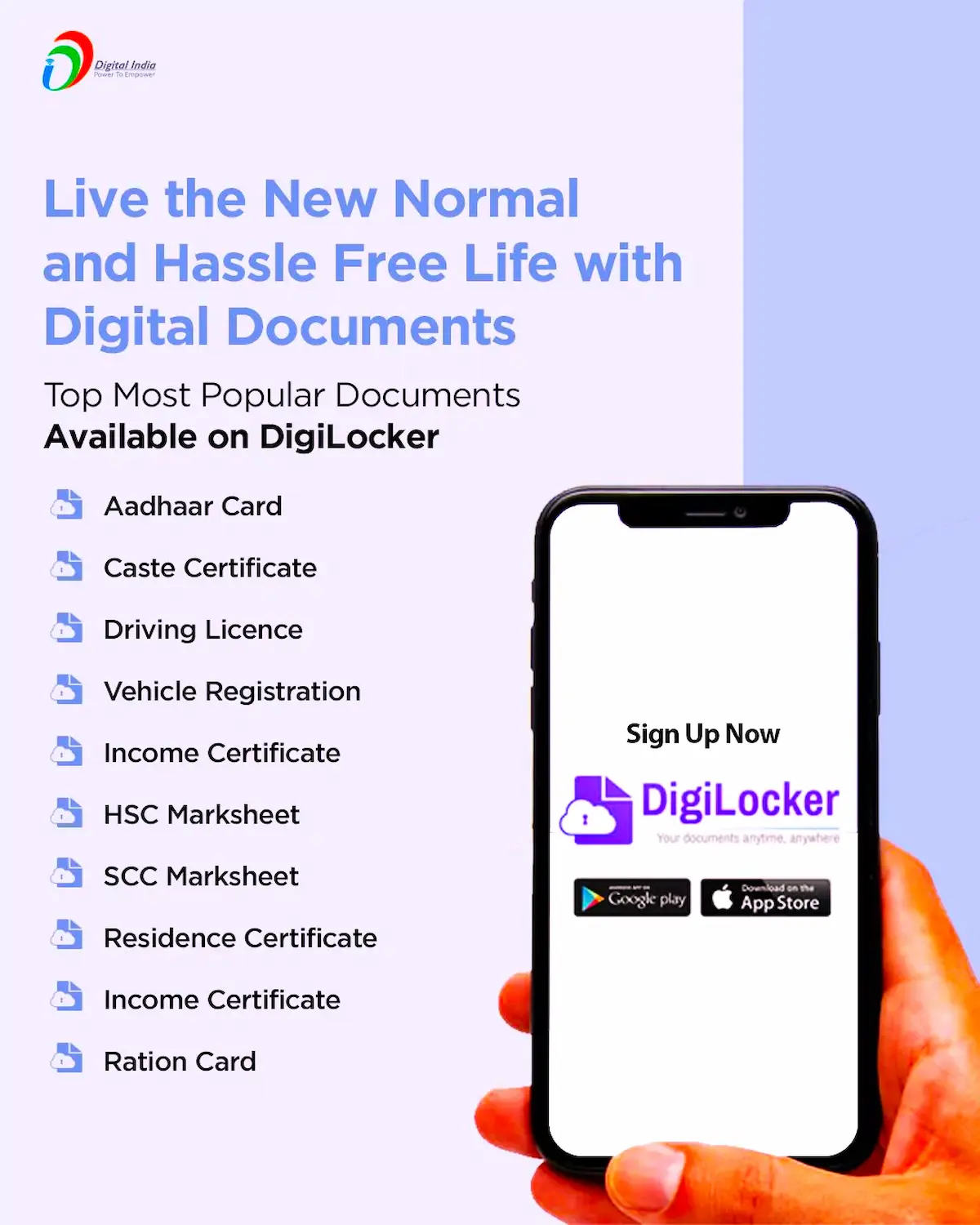
The platform's reach now extends across sectors. The Central Board of Secondary Education (CBSE) issues digital mark sheets and migration certificates directly to DigiLocker. The Ministry of Road Transport and Highways issues driving licences and vehicle registration certificates to DigiLocker. State governments issue caste certificates, income certificates, domicile certificates, and birth certificates. Universities issue degrees and transcripts. The Insurance Regulatory and Development Authority (IRDAI) has mandated that all insurance policies be issued in digital format and available through DigiLocker.
Cowin — the platform that issued over 2 billion COVID-19 vaccination certificates — was built on DigiLocker infrastructure. Every Indian who received a COVID vaccine received their certificate through DigiLocker, whether they realised it or not.
But the growth has not been uniform, and significant challenges remain.
The Issuer Gap
While over 2,500 agencies are connected to DigiLocker, India has tens of thousands of government bodies, school boards, and statutory authorities. Many — particularly in smaller states and rural districts — are not yet integrated. A student whose school board has not joined DigiLocker cannot receive digital mark sheets. A resident of a state where the revenue department has not connected to DigiLocker cannot receive digital caste or income certificates. The infrastructure exists, but the last mile of issuer onboarding remains incomplete.
Digital Literacy and Access
DigiLocker requires a smartphone or internet access, and a basic understanding of digital interfaces. For elderly citizens, those with limited literacy, and those in areas with poor connectivity, this remains a barrier. The government has established Common Service Centres (CSCs) in rural areas to assist with DigiLocker access, but awareness and availability are uneven.
Trust in Digital Documents
Despite the cryptographic security of DigiLocker documents, many institutions — particularly in the private sector — still demand physical copies. Banks, employers, and landlords often insist on seeing original paper documents, even when a digitally signed DigiLocker version is legally valid. Changing institutional behaviour takes longer than building technology.
Where DigiLocker Has Changed Lives
Beyond the aggregate numbers, DigiLocker's impact is most visible in specific use cases where it has genuinely transformed how people interact with institutions.
College admissions. The University Grants Commission (UGC) has directed all universities to accept DigiLocker-issued documents for admissions. A student from a village in Uttar Pradesh applying to Delhi University no longer needs to carry original documents across states. The university verifies their credentials digitally in seconds.
Government recruitment. The Staff Selection Commission and Union Public Service Commission now accept DigiLocker-verified documents. A candidate who clears the civil services examination can submit their educational and caste certificates digitally, eliminating the risk of document loss or forgery in the verification process.
Driving licence and vehicle registration. DigiLocker stores both driving licences and vehicle registration certificates. Under the Motor Vehicles Act, presenting a DigiLocker version of your licence to a traffic police officer is legally equivalent to producing a physical one. This was an early and widely used feature — one of the first to demonstrate DigiLocker's utility to ordinary citizens.
Digital onboarding for SIM cards. Telecom operators now accept Aadhaar-based e-KYC for mobile connections. DigiLocker stores the digital identity documents that enable this process — no paper application forms, no photocopied identity proof.
Insurance policies. IRDAI's mandate to issue digital policies has made DigiLocker a repository for health, life, and vehicle insurance documents. Policyholders no longer need to store physical policy documents that can be lost, damaged, or forged.
Property transactions. Several states have begun integrating land records with DigiLocker. Digitally signed property documents reduce the scope for land fraud — one of India's most persistent sources of litigation — by making ownership records instantly verifiable.
DigiLocker as Geopolitical Infrastructure
DigiLocker is the least internationally visible of India's digital public infrastructure components — and perhaps the most replicable.
Every country in the world has the same document problem India had. Citizens carry paper. Institutions demand physical verification. Governments issue certificates that can be forged, lost, or damaged. The cost of document verification is borne by individuals, businesses, and the state alike.
DigiLocker demonstrates that a country can build a unified, government-issued digital document platform at national scale — and that doing so eliminates an enormous amount of friction, fraud, and cost from the economy.
The World Bank's Identification for Development (ID4D) initiative has studied DigiLocker as a model for document digitisation in developing countries. The African Union's digital transformation strategy references India's paperless layer as a reference architecture. Countries with federal structures — Brazil, Nigeria, Indonesia — face similar challenges of fragmented document issuance across states and agencies, and are potential adopters of the DigiLocker model.
DigiLocker also represents a broader governance philosophy: that the state should provide infrastructure, not just services. Instead of building a centralised document verification agency that processes every verification manually, India built an open platform where any issuer can push documents and any verifier can pull them — with the citizen in control of the data flow. This is the same philosophy that underlies UPI, ONDC, and OCEN.
The Road Ahead
DigiLocker's roadmap is focused on three priorities over the next several years.
1. Universal issuer onboarding. The goal is to connect every document-issuing authority in India — all school boards, all universities, all state revenue departments, all municipal corporations — to DigiLocker. This is as much a governance challenge as a technical one: it requires states to prioritise integration, allocate resources, and overcome bureaucratic inertia.
2. Deepening private-sector acceptance. Legal validity exists — DigiLocker documents are recognised under the Information Technology Act. But cultural acceptance lags. Banks, employers, landlords, and other private institutions need to be educated about the legal equivalence of digital documents and incentivised to adopt digital verification workflows.
3. International interoperability. India is exploring mutual recognition agreements with other countries so that DigiLocker-issued educational certificates, for instance, can be verified by foreign universities and employers. A pilot with the European Union on digital credential recognition is in early stages. If successful, an Indian engineer applying for a job in Germany could have their degree verified via DigiLocker — without an intermediary credential evaluation agency.
Recommended tools & resources
If you want to explore digital governance and document infrastructure deeper, these resources can help.
Disclosure: Links may be affiliate links. See Disclaimer.
The Verdict
DigiLocker is the least glamorous component of India Stack — and arguably the most quietly transformative. It doesn't have the commercial scale of UPI or the geopolitical visibility of Aadhaar. But it solves a problem that affects every Indian, every day: the tyranny of paper.
It has eliminated the need for physical document storage for millions. It has made forgery — a multi-billion-rupee industry in fake certificates and altered documents — enormously harder. It has reduced the cost of verification for every institution that has adopted it. And it has given citizens something they never had before in India's bureaucratic system: control over their own documents.
The platform is not without gaps. Issuer coverage is incomplete. Digital access is uneven. Institutional habits change slowly. But the direction is unambiguous.
DigiLocker represents the same thesis that runs through all of India's digital public infrastructure: that the state's job is to build open, interoperable rails — and let citizens, institutions, and markets build on top of them. Paper is not a technology problem. It is an infrastructure problem. And DigiLocker is proving that a country of 1.4 billion people can solve it.