Table of Contents
The Credit Problem Nobody Talks About
India has over 63 million micro, small and medium enterprises (MSMEs). They employ more than 110 million people and contribute nearly 30% to India's GDP. They are the backbone of the Indian economy.
And yet, they are largely invisible to the formal credit system.
A small shopkeeper in a Tier 2 city needs ₹50,000 to stock inventory before the festive season. A street vendor needs ₹10,000 to buy additional supplies. A gig worker needs a small loan to tide over a slow month. None of them have formal credit scores. None of them have property to offer as collateral. None of them can produce three years of audited financial statements.
Traditional banks see them as too risky and too costly to serve. The paperwork is extensive, the underwriting process is slow, and the loan amounts are too small to justify the effort. Instead, these millions of entrepreneurs turn to informal moneylenders who charge exorbitant interest rates — often 3–5% per month, or 36–60% annually — trapping them in cycles of debt.
Less than 14% of India's MSMEs have access to formal credit. The credit gap for micro-enterprises in India is estimated at over ₹25 lakh crore (approximately $300 billion).
OCEN is India's answer to this problem.
What OCEN Actually Is
The Open Credit Enablement Network (OCEN) is not a lender. It is not a loan product. It is an infrastructure layer — an open protocol that enables any lender, any borrower, and any platform to interoperate on a single network for small-ticket lending.
The best analogy is UPI for credit. Just as UPI made payments interoperable — allowing any bank account to send money to any other bank account — OCEN aims to make credit interoperable. A small business using any accounting platform, e-commerce platform, or banking app can request a loan from any lender on the network. The borrower's data follows them. The lender's decision is portable. No single platform controls the transaction.
OCEN was conceptualised by Nandan Nilekani, the architect of Aadhaar and UPI, in partnership with the Reserve Bank of India (RBI) and the Ministry of Finance. It is designed to leverage India's digital public infrastructure — Aadhaar, UPI, DigiLocker, and Account Aggregator (AA) — to create a new paradigm for small-ticket lending.
Launched as a pilot in 2021, OCEN is now being rolled out across India, with participation from major banks, fintechs, and technology platforms.
How OCEN Works in Practice
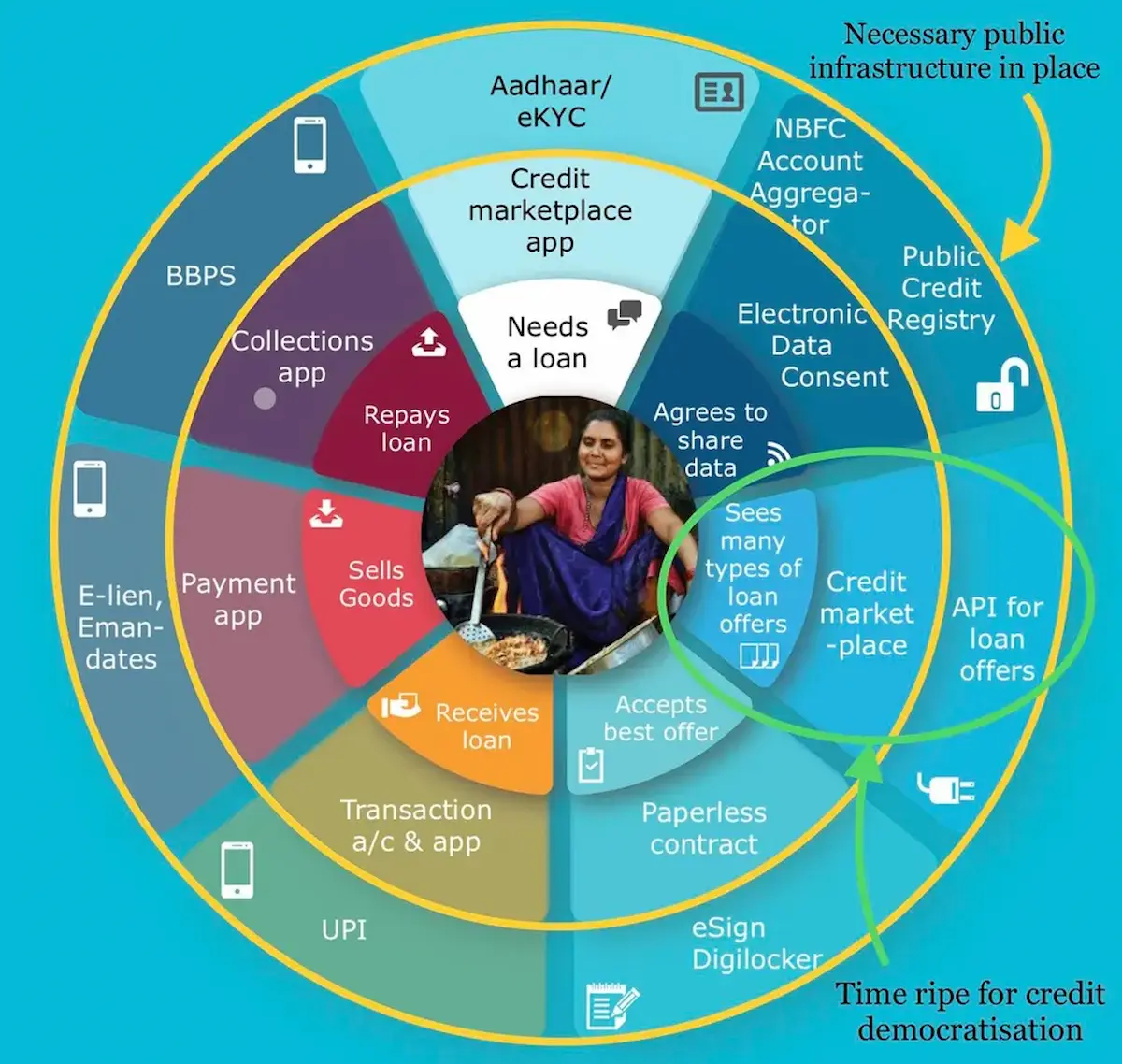
Imagine you are a small grocery store owner. You use a billing software like Khatabook to track your daily sales. During a festival season, you need a loan of ₹30,000 to buy extra inventory.
Here is what happens with OCEN:
1. Request. Through your billing app, you request a loan. You don't need to visit a bank or fill out lengthy forms.
2. Data sharing. With your consent, the billing app — acting as a Loan Service Provider (LSP) — securely shares your sales data through the Account Aggregator framework. This includes how much you sell daily, your typical profit margins, and your repayment patterns with wholesalers.
3. Underwriting. Lenders on the OCEN network — acting as Lenders — access this data and make a lending decision using their algorithms. Because they have actual cash-flow data, they can underwrite you without requiring traditional collateral or credit scores.
4. Offer. One or more lenders present loan offers directly in your billing app. You see the interest rate, repayment terms, and total cost upfront.
5. Acceptance. You select the best offer. The loan is disbursed directly to your bank account via the UPI payment infrastructure.
6. Repayment. The loan is repaid automatically through your daily sales — a small percentage of each day's revenue goes toward the loan repayment. This aligns the repayment schedule with your cash flow, reducing the risk of default.
The entire process takes minutes, not days or weeks. You get credit when you need it, at competitive rates, without collateral or lengthy paperwork.
The Architecture of OCEN
OCEN is built on three core principles:
1. Consent-Based Data Sharing
Data is the new collateral. OCEN uses the Account Aggregator framework, where borrowers can securely share their financial data — bank statements, GST filings, sales data, utility payments — with potential lenders. The borrower's consent is required for every data transfer, and the data flows directly from the source to the lender without passing through intermediaries. This eliminates the need for traditional credit scores based on limited data.
2. Plug-and-Play Infrastructure
The OCEN protocol allows any platform — e-commerce, accounting, logistics, retail, or banking — to become a distribution channel for credit. This creates competition among lenders and platforms, driving down costs and increasing access. Sellers on ONDC, for instance, can access working capital loans through OCEN based on their transaction history.
3. Digital-First Lending
Underwriting is done entirely through digital data. No physical visits, no manual document verification, no lengthy approval processes. This reduces the cost of origination and allows lenders to profitably serve customers who were previously considered too expensive to reach.
The Growth Story — and Its Challenges
OCEN is still in its early days, but the potential is enormous.
Scale. Over 500 million Indian adults are eligible for formal credit but have no credit history. OCEN can bring them into the formal financial system.
Economic Impact. Access to credit is correlated with business growth, job creation, and poverty reduction. OCEN could unlock trillions of rupees in productive lending to small businesses.
Financial Inclusion. By making credit accessible to the informal sector, OCEN complements the financial inclusion achieved through UPI and Jan-Dhan accounts. It completes the trinity: identity (Aadhaar), payments (UPI), and credit (OCEN).
But the path is not straightforward.
The Data Privacy Challenge
OCEN depends on data sharing. The Account Aggregator framework is designed to be privacy-preserving — but it is only as strong as the consent mechanisms that underpin it. As with Aadhaar, there are concerns about mission creep: will data shared for credit access be used for other purposes? Will borrowers understand what they are consenting to? How will disputes be resolved?
The Quality of Data
OCEN's underwriting models are only as good as the data they use. Inconsistent GST filings, incomplete sales data, and poor record-keeping can lead to rejection. Building digital literacy and encouraging better financial documentation is essential.
The Liquidity Problem
For OCEN to work, lenders must have sufficient capital to deploy. Banks and NBFCs are cautious about lending to unproven segments. The government has announced a ₹1.6 lakh crore credit guarantee scheme to encourage lending to MSMEs through platforms like OCEN — but the guarantee is only as effective as its implementation.
The Trust Deficit
Small businesses have been burned by aggressive fintech lenders in the past — high-pressure sales, hidden fees, coercive collection practices. Building trust in the system is as important as building the technology.
OCEN in the Global Context
OCEN is part of a broader movement toward open finance, where data and services are interoperable across platforms.
In the United States, the Consumer Financial Protection Bureau (CFPB) is working on regulations that would allow consumers to share their financial data with third parties through "open banking" standards. In the European Union, the Revised Payment Services Directive (PSD2) mandates banks to share customer data with authorised third parties.
But India is unique in the scale and ambition of its approach. OCEN is not just about data sharing — it is about building a complete credit infrastructure from the ground up, designed for a population that has historically been excluded from formal finance.
The Australian government has studied India's public digital infrastructure model as a potential framework for its own digital identity and payments systems. The United Kingdom has expressed interest in learning from India's experience with open credit networks.
The Road Ahead
OCEN's developers are focused on three priorities:
1. Expanding the Network. More lenders, more platforms, and more borrower segments. The goal is to create a vibrant ecosystem where credit flows efficiently to those who need it.
2. Improving Underwriting. Better data, better models, and better outcomes. AI and machine learning are being deployed to analyse alternative data — utility payments, mobile phone usage, social media activity — to make more accurate lending decisions.
3. Strengthening Governance. Clearer regulations, stronger consumer protections, and better dispute resolution mechanisms. The RBI is working on a framework for digital lending that balances innovation with financial stability.
Recommended tools & resources
If you want to explore open credit and digital lending infrastructure deeper, these resources can help.
Disclosure: Links may be affiliate links. See Disclaimer.
The Verdict
OCEN is neither the revolution its supporters claim nor the risk its critics suggest. It is an infrastructure project in its early stages: full of potential, facing real challenges, and far from proving its case.
The direction is right. An India where 63 million small businesses can access affordable credit without collateral or lengthy paperwork would be a more competitive and more equitable economy. Whether OCEN achieves that vision depends on execution, trust, and whether the government continues to invest in the infrastructure even when the results are uncertain.
The closed credit model had decades to entrench itself. Open infrastructure deserves more than a few years to prove its case.