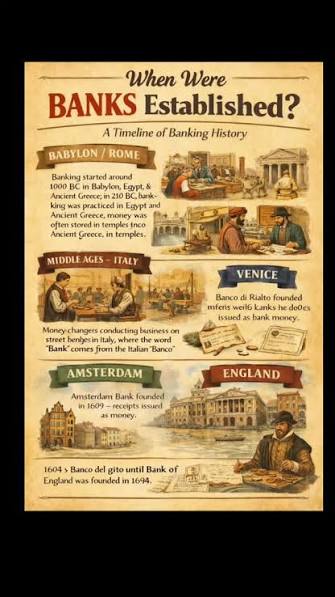
The Babylonian Revolution: Debt — A Powerful Tool for Control
The Financial Discovery
The Sumerians discovered control through knowledge. The Egyptians perfected control through religion. But the Babylonians went to an entirely new level — they discovered control through money and debt.
This was a revolutionary discovery: they realized that binding a person economically was far more effective than making them a physical slave. Slavery leads to rebellion — but debt creates trust, responsibility, and obedience. Chain a man and he will fight back. But put him in debt he cannot repay, and he remains obedient. That was the Babylonian genius.
Temple Banks
Babylonian temples were not just places of prayer — they were the world's first full-fledged financial institutions. These temples served three key functions:
Banking Centers: They gave farmers loans for seeds and agricultural tools for their crops. Everything a farmer needed to work his land came as a loan from the temple. This meant — from the very first day of his life, the farmer was indebted to the temple.
Storage Centers: They had complete control over grain stores. Farmers had to store their harvest in temple granaries. The temple decided how much grain there was and who got what. He who controls food controls the people.
Education Centers: They taught accounting and business practices. Calculations, contracts, and loan records were preserved on clay tablets in cuneiform. This education was also limited to the priest class — ordinary people could not even read their own loan agreements.
The Interest Trap — How Debt Became Slavery
This was a highly sophisticated economic system. When farmers who took loans could not repay:
Land Seizure: The farmer lost his land. That land became "temple land belonging to god" — but in reality, it went under the priest class's control. After a few generations, almost all land in a region was held in the temple's name.
Lifetime Servitude: After losing land, the farmer and his family became lifetime servants of the temple. They worked temple lands, produced food for the temple, and built temple structures.
Generational Debt: The cruelest part — their children also inherited the same debts. A single debt bound a family to the temple for three, four generations. This was slavery by birthright — but the chains were invisible. The farmer did not consider himself a slave, but he was one. And this slavery was done legally — in the name of debt, interest, and contracts.
This was the Babylonian genius. They did not enslave people with swords and armies. They enslaved them with debt. Debt was invisible chains. And invisible chains are far stronger than visible ones.
Legacy
This Babylonian economic system is the foundation of modern banking. The stock markets, credit systems, and mortgage loans we use today all began thousands of years ago in Babylon. The fundamental principle of control has not changed: binding people economically is a far more powerful control tool than binding them physically.
The Babylonians taught an important lesson: armies can conquer empires, but economic systems can control societies. Debt is not merely a financial tool — it is the most powerful weapon of control.
This is the fourth article in the "History of the Controllers of the World" series. In the next article, read about Greek philosophy, Plato's Allegory of the Cave, controlled ideologies, and culture wars.