Greek Philosophy: Controlled Resistance — and Controlled Opposition
The Change — A New Problem
Around 400 BCE, the controllers faced a major problem. In the Egyptian system, people had to directly believe the Pharaoh was god. In the Babylonian system, debt directly bound people. But this direct control had a flaw — rebellions. When people realized they were being controlled, they fought back. Individuals like Akhenaten rose up and stood against the system.
The Greek controllers asked a new, more sophisticated question: what if people believe they are free, while actually being controlled? If people are given the illusion of choice, and those choices are predetermined — they will not rebel. Because they believe "we are free."
Pythagoras — Knowledge Transfer from Egypt to Greece
Pythagoras was a key figure in this new control system. He trained in ancient Egyptian Mystery Schools — where he learned all the ancient secrets of control. The step-by-step knowledge revealed in Egyptian mystery schools — sacred geometry, ratios, astronomy, natural laws — Pythagoras learned all of this.
But what he did was revolutionary: he returned to Greece and offered limited knowledge to the public. He did not give complete knowledge — but he gave some. This created a sense of freedom among people — they believed they were "receiving knowledge" — but that knowledge remained within prescribed limits.
Pythagoras established a mystery school where he taught two levels of knowledge. To outer students, he taught basic mathematics and music — but to inner students, he gave the real secrets of control. The Egyptian model was reflected in Greece — a two-tier system.
Plato's Allegory — The Cave
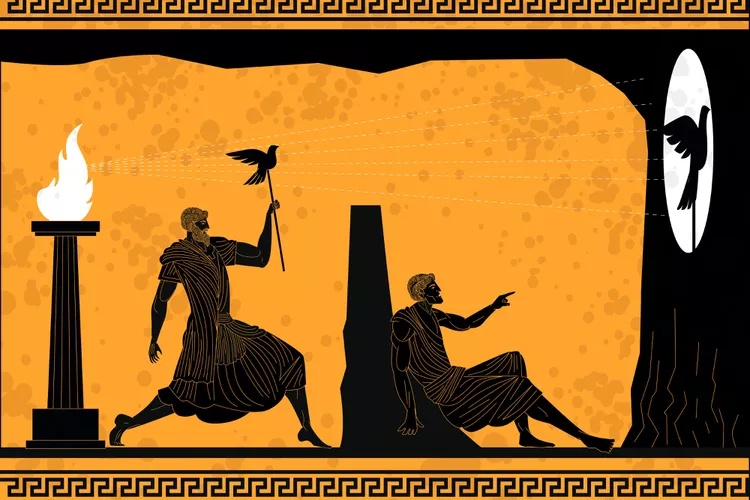
Plato, through his famous 'Allegory of the Cave,' described the complete picture of the control system. In this allegory, people are chained in a cave and can only see shadows on the wall. They believe those shadows are reality — because they cannot see anything else.
Plato revealed a profound truth through this allegory: people are seeing only shadows — they have no opportunity to see the real truth. Those who decide what shadows to display, which shadows to show, and when to show them — they are the real controllers. But the people in the cave do not know they are being controlled — they believe they are free.
Note — Plato did not tell this allegory to ordinary people. This was a secret teaching for those trained in philosophy, in mystery schools. But because Plato wrote it openly, it is still available to us today.
Controlled Ideologies
The most advanced control tool of Greek philosophy was controlled ideologies. The controllers introduced three main ideologies to the people:
Communism: Controlling the distribution of property and resources. People support this system hoping everything will be shared equally — but the actual control of distribution remains in the controllers' hands.
Capitalism: Controlling wealth and the economy. People are given the belief that anyone can become rich through hard work — but the rules of the game are predetermined from the start.
Socialism: Government and social control. People believe government control is necessary to protect society — but the question is who controls that government.
Culture Wars — Dividing the People
Making people clash between these three ideologies is the real strategy. This is "Culture Wars." If people fight among themselves, real knowledge remains beyond their reach. People immersed in debates about which ideology is right never ask the question of who is controlling them.
Left, right, center — people immersed in debates among these three ideologies forget who is providing them information. If people fight among themselves, the controllers remain safe. This is the most powerful strategy of the Greek model.
Controlled Opposition
Here there is an even deeper strategy — Controlled Opposition. Why are the controllers controllers? Because they are controllers. They are very smart. They establish and run a system. But that system eventually ends or collapses. Then they create new systems.
They start infiltrating whatever forces come against their existing system. That is — rather than fighting opposition from outside, they go inside and take control of it. People think "we are fighting against the system" — but they are actually participating in an opposition movement created by the controllers.
This happened in Akhenaten's story too. The monotheistic traditions born from Akhenaten's revolution — Judaism, Christianity, Islam — were taken over by the controllers. Even religions born as opposition forces were infiltrated. People think "we follow a religion opposed to the controllers" — but that religion too has gone into the controllers' hands.
This same method is visible in today's politics. Every party, every movement, every protest — how many are genuine opposition movements? How many are "controlled opposition" created by the controllers? People think they are fighting — but the very war they fight is also run by the controllers.
The Legacy of the Greek Model
Greek philosophy marks a major turning point in control history. Sumerians hid knowledge to control. Egyptians used religion to control. Babylonians used money to control. But the Greeks learned to control thought — giving people the illusion of choice while predetermining those choices.
This Greek model has become the most influential control system in today's modern world. Political parties, media organizations, educational institutions — all follow this model. People are given the illusion of choice, but those choices always remain within predetermined limits. Every opposition movement has the controllers' hand in it.
This is the fifth article in the "History of the Controllers of the World" series. In the next article, read about the controllers' journey — from Egypt to Rome, from Rome to the modern world.