Table of Contents
The Logistics Problem Nobody Talked About
India's logistics sector is vast, complex, and profoundly fragmented. Goods move across one of the world's largest and most diverse geographies — by road, rail, ocean, and air — involving millions of small transporters, thousands of intermediaries, and dozens of government agencies, each with its own data systems, its own paperwork, and its own silos.
Before 2022, a manufacturer shipping goods from one state to another had no single view of where their cargo was. A small transporter had no way to verify a driver's credentials against a government database. A logistics planner had no real-time data on port congestion, rail availability, or road conditions. Information was scattered across ministries, locked in proprietary systems, or simply unavailable. The result was not merely inconvenience — it was a structural tax on every product that moved through the Indian economy.
India's logistics costs were estimated at 13-14% of GDP — significantly higher than the global benchmark of 7-8%. Trucks spent hours waiting at checkpoints. Containers sat idle at ports. Perishable goods spoiled in transit because no one knew where they were or when they would arrive. Small players were squeezed out by larger operators who could afford their own data systems and their own relationships with government agencies.
This was not just inefficiency. It was exclusion by design. The cost of logistics data — knowing where your cargo is, whether your driver is verified, which port is least congested — was borne disproportionately by the smallest players who needed it most. India's logistics sector was not merely expensive. It was structured to keep small players small.
ULIP is India's answer to this problem.
What ULIP Actually Is
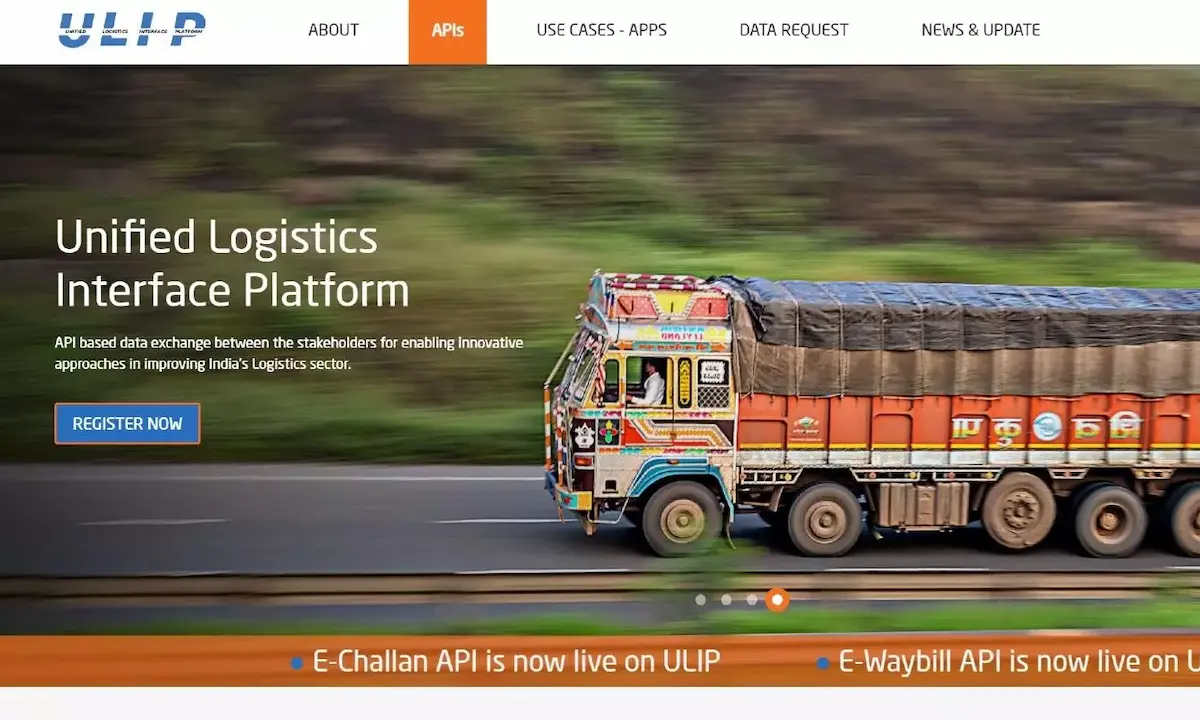
The Unified Logistics Interface Platform (ULIP) is not a logistics company. It is not a tracking app. It is a digital gateway — an infrastructure layer that allows any logistics stakeholder to access logistics-related datasets from various government systems through API-based integration.
The best analogy is UPI for logistics. Just as UPI made payments interoperable — allowing any bank to talk to any other bank through a single protocol — ULIP makes logistics data interoperable. A small trucking company, a multinational manufacturer, a state government, and a port authority can all access the same data, using the same standards, through a single digital gateway. No one owns the data. The government builds the pipes. Private companies build the applications on top.
ULIP was conceptualised by NITI Aayog and is operated by NICDC Logistics Data Services Limited (NLDSL) — a joint venture between the Government of India, represented by the National Industrial Corridor Development and Implementation Trust (NICDIT), and Japanese IT major NEC Corporation, with 50:50 equity participation. The public-private structure is notable: the government provides the data and the mandate; NEC provides the technology and operational expertise. It is an unusual institutional form for Indian digital infrastructure, and it reflects the technical complexity of integrating 45 government systems into a single API layer.
The platform was launched by Prime Minister Narendra Modi under the National Logistics Policy (NLP) on 17 September 2022. Its core objective is straightforward: democratise access to logistics data for all stakeholders — from small transporters to large corporations to government planners — so that logistics decisions are driven by data, not by relationships.
How ULIP Works in Practice
ULIP's architecture is simple but structurally transformative. It replaces a world of fragmented, siloed, relationship-dependent data access with a single, standards-based API gateway.
The Data Integration Layer
ULIP integrates with 45 systems across 11 central ministries and departments through 137 APIs, covering over 2,000 data fields. This includes port and customs data from the Ministry of Shipping, rail and road transport information from the Ministries of Railways and Road Transport, shipping and airline schedules, warehousing and terminal data, and regulatory compliance systems from multiple agencies. Each of these systems was built independently, at different times, for different purposes, using different data formats. ULIP's core technical achievement is not building new data — it is making existing data talk to each other.
For Businesses
Any registered company can sign up on the ULIP portal (www.goulip.in). Through API-based access, they can track cargo in real-time across all modes of transport — road, rail, ocean, air — getting real-time ETAs and shipment status. They can verify transporters and drivers by accessing government databases to check vehicle registrations, driver licences, and compliance status — a capability that previously required relationships with individual government departments. They can optimise supply chains by identifying cheaper or faster logistics modes, managing inventory just-in-time, and reducing delays. And they can automate documentation, regulatory filings, and compliance checks — reducing paperwork and the human error that comes with it.
For Government
ULIP provides data-driven decision support to ministries and state governments. Real-time logistics insights help with infrastructure planning, policy-making, and performance monitoring. State governments like Andhra Pradesh and Maharashtra have signed MoUs with NLDSL to build integrated logistics dashboards for monitoring logistics KPIs across departments. For the first time, a state government can see — in real time — how goods are moving through its territory, where the bottlenecks are, and which interventions would have the highest return.
The "Track Your Transport" App
For small transporters and traders who cannot afford heavy IT infrastructure — and who form the vast majority of India's logistics sector — NLDSL launched the Track Your Transport (TYT) app. Available on web, Android, and iOS, it provides cargo tracking, vehicle verification, and driver validation — democratising access to digital logistics tools for the unorganised sector. This is the inclusion layer: the recognition that APIs alone do not reach a truck driver with a feature phone, and that the platform must meet users where they are.
The Growth Story — and Its Achievements
ULIP's growth has been rapid. In just a few years, it has become a foundational layer of India's logistics digital infrastructure.
Scale
As of early 2026, ULIP has recorded over 300 crore API transactions, with the platform processing an average of 1 crore API transactions weekly. Over 1,300 companies are registered on the ULIP portal, with more than 350 agreements signed. Over 240 innovative applications have been developed by private companies using ULIP data — applications that would not exist without the underlying data infrastructure.
Integration
ULIP now connects 45 systems across 11 central ministries and departments through 137 APIs, covering over 2,000 data fields. This represents a significant expansion from its initial 37 systems and 118 APIs at launch. The direction of travel is clear: more systems, more data fields, more granularity.
Private Sector Adoption
Major manufacturers such as Prism Johnson, Asian Paints, and Tata Steel use ULIP's APIs for transporter verification and supply chain optimisation. Logistics service providers like Cuttack Carriers, Road Pilot, and Intugine use the platform for digital documentation and freight movement automation. Transporters and logistics providers are reducing empty movement and waiting time — two of the largest sources of waste in Indian logistics — cutting operational and maintenance costs in the process. Century Plywoods and Transport Corporation of India Limited (TCIL) leverage the platform to adopt environmentally friendly alternatives, aligning with India's carbon reduction goals.
State Government Adoption
State governments are integrating ULIP into their logistics planning. The Government of Andhra Pradesh signed an MoU with NLDSL in November 2025 to digitise the state's logistics ecosystem. The Government of Maharashtra signed a similar MoU in April 2026 to build a unified digital platform for the state, with participation from over 10 state departments. These are not ceremonial agreements — they represent the integration of state-level logistics data into a national framework, closing the gap between central infrastructure and state-level operations.
Impactful Initiatives
NLDSL has launched the ULIP Hackathon 2.0, inviting developers, startups, and industry players to build innovative solutions addressing logistics challenges — sustainability, complex supply chains, unified documentation, and multimodal optimisation. Beyond ULIP, NLDSL operates the Logistics Data Bank (LDB), which tracks containers across 101 Inland Container Depots (ICDs), covering 100% of India's EXIM container volume and tracking over 91 million EXIM containers since inception.
What ULIP Gets Right
Despite the complexity of building a national logistics data platform, ULIP has several structural strengths.
1. Democratising Access to Data
ULIP's core purpose is democratisation. Before ULIP, logistics data was fragmented across government silos, accessible only to those with connections or the resources to build their own systems. ULIP provides a single, standardised gateway for any business — from a small transporter with a single truck to a multinational corporation — to access the same data through the same APIs. This breaks the monopolistic control over logistics information that previously favoured large, politically connected operators.
2. Interoperability by Design
ULIP is built on standards-based APIs. Any company can build applications on top of the platform, as long as they use the same standards. This creates a competitive ecosystem where multiple solutions can coexist, driving innovation and keeping costs down. The 240 applications built on ULIP are evidence that the platform model works: the government does not need to build tracking apps, verification services, or optimisation tools. It only needs to provide the data layer, and the market builds the rest.
3. Integration with India Stack
ULIP is designed to work with other Digital Public Infrastructure components. It leverages the same principles — API-first design, consent-based data sharing, open standards — that made UPI, Aadhaar, and DigiLocker successful. A transporter verified through ULIP's APIs is verified against the same government databases that power Aadhaar and DigiLocker. The layers reinforce each other.
4. Government as Enabler, Not Operator
The government, through NLDSL, builds the infrastructure — the APIs, the data standards, the security frameworks. Private companies build the applications and services on top. This is the classic India Stack model: public infrastructure, private innovation. The government does not compete with logistics startups. It enables them.
5. Inclusion of the Unorganised Sector
The Track Your Transport app is a direct effort to reach the millions of small transporters and traders who form the backbone of India's logistics sector but who lack the technical capacity to integrate with APIs. By providing a free, user-friendly digital tool, ULIP is bringing the unorganised sector into the digital ecosystem — not as a charitable afterthought, but as a core design requirement.
The Problems Nobody Talks About
ULIP's expansion has not been without structural challenges.
The Fragmentation Problem
Despite ULIP's integration of 45 systems, India's logistics governance remains fragmented at the institutional level. Interoperability standards are uneven, and governance across transport modes — road, rail, ocean, air — is not fully aligned. Each mode operates under a different ministry, with different regulations, different data standards, and different institutional cultures. ULIP provides the digital glue, but it cannot, by itself, harmonise the underlying institutional fragmentation. Data integration is necessary but not sufficient.
The Digital Divide
Not everyone has the capacity to use APIs — or even smartphones. While the Track Your Transport app helps, millions of small transporters lack smartphones, internet connectivity, or digital literacy. The digital divide remains a real barrier to full participation, and it is concentrated among the smallest operators who would benefit most from the platform. An API gateway that 1,300 companies use is impressive. But there are millions of logistics operators in India, and most of them are not on ULIP yet.
Data Quality and Trust
ULIP is only as good as the data it integrates. Inconsistent data quality, incomplete records, and outdated information from source systems can undermine trust in the platform. If a transporter verification API returns a false negative — or worse, a false positive — the consequences are not theoretical. Ensuring data accuracy across 45 independently operated government systems is a significant and ongoing operational challenge that has no simple technical fix.
The Cost of Transformation
While ULIP reduces costs for users who adopt it, the transformation to digital logistics requires upfront investment — in devices, connectivity, training, and process change. Small operators may struggle to adapt even when the tools are free, because the cost is not in the software but in the organisational change required to use it effectively. The government is working on training and support programmes, but the transition is inherently uneven.
The Physical-Digital Gap
India's logistics cost remains high — estimated at 13-14% of GDP compared to the global benchmark of 7-8%. ULIP is a critical tool for reducing these costs through better data, better routing, and better utilisation. But it is not a silver bullet. Physical infrastructure — ports, roads, railways, warehousing — must also improve to realise the full benefits of digital integration. A perfectly optimised digital supply chain still moves through congested ports and potholed roads. Digital infrastructure can reduce waste at the margins, but it cannot substitute for physical infrastructure.
ULIP in the Global Context
India is not the only country building digital logistics platforms. The European Union has the Digital Logistics Platform for Europe. China has its National Logistics Platform. The United States has the Freight Logistics Optimization Works (FLOW) initiative.
But India's approach is architecturally distinct. Most systems are either government-led command-and-control platforms — where the state builds and operates the entire system — or private-sector initiatives with limited interoperability, where each company builds its own data and guards it. ULIP is a hybrid: government builds the data infrastructure and defines the standards; private sector builds the applications; and open APIs ensure interoperability across both. This is the same design pattern as UPI and ONDC, applied to a domain — physical logistics — that is far messier than digital payments.
ULIP's scale is also notable. No other country has attempted to integrate 45 government systems across 11 ministries into a single API gateway covering over 2,000 data fields. The ambition is to create a national logistics data fabric that supports not just private sector efficiency but also data-driven governance — where a policymaker can see, in near real-time, how goods are moving across the country, where the bottlenecks are, and which investments would yield the highest return. Whether ULIP achieves that ambition depends on whether the data remains accurate, the APIs remain open, and the state governments continue to integrate.
The Road Ahead
NLDSL's leadership is focused on several priorities as the platform matures.
Expanding Integration
The platform is working to integrate more systems — more ministries, more states, more logistics nodes. The goal is to make ULIP the single source of truth for logistics data in India, covering every mode, every corridor, and every government system that touches the movement of goods.
Deepening State Adoption
The MoUs with Andhra Pradesh and Maharashtra are the beginning. The next phase will focus on helping states build their own logistics dashboards and integrate their departmental data with ULIP. State-level adoption is the key to reaching the district and local levels where much of India's logistics friction occurs.
Fostering Innovation
Hackathons like ULIP Hackathon 2.0 are designed to accelerate application development. The goal is to create a vibrant ecosystem of logistics apps — fleet management, cargo insurance, route optimisation, compliance automation — all built on the same data infrastructure, all competing on user experience rather than data access.
Reducing Logistics Costs
The ultimate objective is to bring India's logistics costs down to global benchmarks — from 13-14% of GDP to 7-8%. This requires not just digital infrastructure but also physical infrastructure, policy reforms, and skill development. ULIP is one piece of a larger puzzle. But it is the piece that makes all the other pieces visible, measurable, and optimisable.
Recommended tools & resources
If you want to explore logistics, supply chains, and digital infrastructure deeper, these resources can help.
Disclosure: Links may be affiliate links. See Disclaimer.
The Verdict
ULIP is neither the perfect solution its supporters claim nor the bureaucratic initiative its critics suggest. It is an infrastructure project in the middle of its most difficult phase — past the initial enthusiasm, not yet at universal coverage, dealing with real problems that have no easy solutions.
The direction is right. An India where logistics data flows freely — across modes, across ministries, across states — and where small transporters compete on a level playing field with large operators would be a more efficient, equitable, and globally competitive economy. The numbers are real: 300 crore API transactions, 1,300 registered companies, 240 applications built, 45 government systems integrated. The private sector is building on the platform. State governments are signing on. The infrastructure is proving itself.
But the challenges are also real. Institutional fragmentation across transport modes persists, and ULIP cannot harmonise governance structures by itself. The digital divide excludes the smallest operators — the very ones the platform is designed to empower. Data quality across 45 source systems is an ongoing operational challenge with no simple fix. And the gap between 13-14% logistics costs and the 7-8% global benchmark will not be closed by digital infrastructure alone.
The old logistics system had decades to entrench itself — and the fragmentation that defined it was not accidental. It benefited those who controlled information, who had relationships with government agencies, and who could afford their own data systems. ULIP threatens that order. Whether it succeeds depends on whether the data stays open, the APIs stay accessible, and the smallest transporters — not just the 1,300 companies on the portal — find value in the platform. The architecture is built. The test now is whether it reaches the millions who move India's goods every day.