Table of Contents
The Welfare Problem Nobody Talked About
For decades, India's welfare system was a leaky pipeline. Subsidies meant for the poor were siphoned off by middlemen, lost to ghost beneficiaries, or delayed indefinitely by bureaucratic inertia. A farmer in a remote village waited months for fertilizer subsidies that never arrived. A widow's pension was swallowed by administrative friction. LPG cylinders intended for poor households ended up in the kitchens of the wealthy — sold on the black market at a premium.
The old system was built on paper — ration cards, identity documents, and manual disbursements. There was no way to verify who was receiving benefits, whether they were eligible, or whether the same person was claiming benefits under five different identities. The result was fraud on an industrial scale. Estimates suggest that leakages accounted for nearly 2% of GDP annually — billions of dollars that never reached the people it was meant to help. The structural problem was not that the government lacked the will to deliver welfare. It was that the delivery mechanism itself — paper, middlemen, manual verification — was designed for leakage.
Direct Benefit Transfer (DBT) was India's answer to this problem. And it is, in many ways, the culmination of everything India Stack was designed to do.
What DBT Actually Is
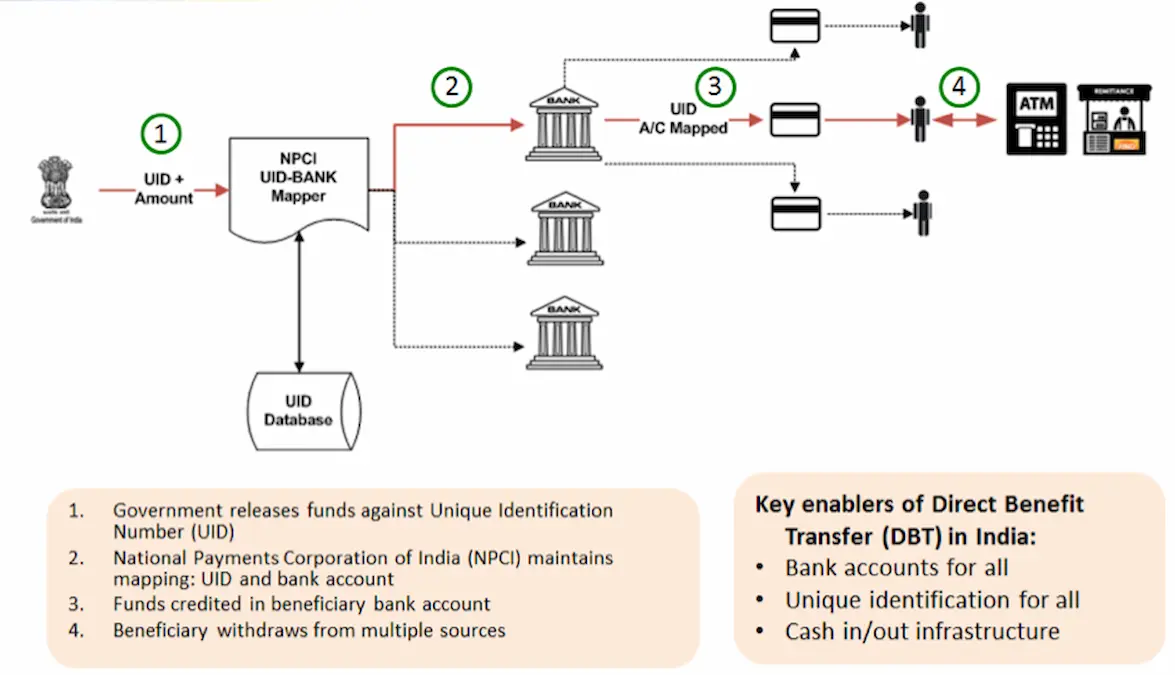
DBT is not just a payment system. It is a fundamental redesign of how government delivers welfare — a shift from opaque, paper-based disbursals to transparent, digital transfers directly into the bank accounts of intended beneficiaries. The architecture is deceptively simple: identify the beneficiary, authenticate their identity, transfer the money, and confirm receipt. The execution, at the scale of 176 crore beneficiaries across 1,650 government schemes, is anything but simple.
The system is built on the JAM Trinity — Jan Dhan bank accounts, Aadhaar unique IDs, and Mobile connectivity. Together, these three components create a secure, transparent pipeline for benefit delivery:
Jan Dhan: Over 58 crore zero-balance bank accounts, with more than 56% held by women and 67% in rural and semi-urban areas. This ensures that even the poorest — those the formal banking sector had written off as unprofitable — have a bank account to receive funds.
Aadhaar: Over 141 crore unique biometric IDs that provide a verifiable digital identity for every resident. This eliminates ghost beneficiaries — people who exist only on paper — and ensures funds reach the right person. When a benefit is claimed, the system asks: is this a real person, with a real fingerprint, linked to a real bank account?
Mobile: Tele-density rising from 75% to 85%, with over 97 crore internet subscribers. This enables real-time notifications, authentication, and access to digital services. When money arrives in a beneficiary's account, they know within seconds.
The Public Financial Management System (PFMS) acts as the payment engine, processing DBT payments by routing funds from the government to beneficiaries' bank accounts through the Aadhaar Payment Bridge. PFMS is the plumbing — invisible, unglamorous, and absolutely essential.
The design philosophy is the same one that runs through UPI, Aadhaar, and DigiLocker: build a shared, interoperable infrastructure layer, and let government schemes plug into it. Each scheme defines its own eligibility rules. DBT provides the delivery pipe. The pipe does not care which scheme is using it — it just ensures the money reaches the right person.
How DBT Works in Practice
Imagine you are a small farmer in rural India. Under the old system, you would wait months for fertilizer subsidies — and much of it would never reach you. The process required visits to government offices, documents you did not have, and intermediaries who took their cut. Under DBT, the process is automated and de-intermediated:
1. Eligibility. The government identifies you as a beneficiary based on land records and Aadhaar-linked identity. No application required. No intermediary needed.
2. Authentication. Your identity is verified through Aadhaar — a biometric match that confirms you are who you claim to be, and that you have not already claimed the benefit under another identity.
3. Transfer. Funds are transferred directly to your Aadhaar-seeded Jan Dhan account through PFMS. The payment is processed in days, not months. No one in the middle can intercept it, delay it, or take a commission.
4. Notification. You receive an SMS on your mobile phone confirming the deposit — the amount, the scheme, the date.
5. Verification. The system cross-checks your Aadhaar and bank account details to prevent fraud. Every transaction leaves a digital trail that can be audited.
This same process works across 450 central schemes and 1,200 state schemes — from LPG subsidies and scholarships to pensions and crop insurance. The architecture is the same regardless of the benefit. The pipe is the same regardless of what flows through it.
The Growth Story — and Its Achievements
DBT's transformation has been extraordinary. In just over a decade, it has become a global benchmark for welfare delivery.
Scale
Since 2014, cumulative DBT transfers have exceeded ₹49 lakh crore across more than 450 central and 1,200 state schemes. In FY 2024-25 alone, ₹6.7 lakh crore was transferred through 181.64 crore transactions. Beneficiary coverage surged 16-fold — from just 11 crore in 2014 to over 176 crore today. To put that in perspective: India now transfers welfare benefits to more people than the entire population of every country except China.
Leakage Reduction
The savings are staggering. Cumulative leakage reduction has reached ₹3.48 lakh crore — enough to fund India's education or health budget for years. This was achieved by eliminating over 10 crore fake or duplicate beneficiaries and reducing subsidy expenditure from 16% to 9% of total government spending. These are not accounting adjustments. They are real people — ghost beneficiaries — who were receiving money that should have gone to real people. DBT made them disappear, not by policy directive but by architectural design: if you cannot biometrically authenticate, you cannot receive the benefit.
Sectoral Impact
The sectoral savings tell the story of where leakage was concentrated — and where DBT had the most impact:
Food Subsidies (PDS): ₹1.85 lakh crore saved through Aadhaar-linked ration card authentication — accounting for 53% of total DBT savings. The Public Distribution System, long notorious as India's most leaky welfare programme, was the single largest source of savings.
MGNREGS: 98% of wages transferred on time, saving ₹42,534 crore through DBT-driven accountability. The rural employment guarantee scheme, once a byword for delayed payments and ghost workers, became one of DBT's strongest demonstrations of operational efficiency.
PM-KISAN: ₹22,106 crore saved by deleting 2.1 crore ineligible beneficiaries — people who were receiving farmer income support despite not being farmers, or receiving it multiple times under different identities.
Fertilizer Subsidies: 158 lakh MT of fertilizer sales reduced, saving ₹18,699.8 crore through targeted disbursement. Fertilizer subsidies had long been diverted to non-agricultural uses or smuggled across borders. DBT made diversion harder — not impossible, but harder — by linking subsidy release to verified purchase.
Financial Inclusion
The Jan Dhan Yojana alone has opened over 58 crore accounts, with more than 56% held by women and 67% in rural and semi-urban areas. This has brought millions into the formal banking system for the first time — people who had never entered a bank branch, who had no credit history, who were invisible to the financial system. They now have accounts. They receive benefits. They are building transaction histories that can, over time, unlock access to credit, insurance, and savings products.
Women's Empowerment
Women have been the biggest beneficiaries of DBT. Over 30 crore Jan Dhan accounts belong to women. Schemes like PM-Ujjwala, PM-KISAN, and state-level women's cash transfer schemes have enhanced financial autonomy and household decision-making power, promoted savings and financial literacy, and increased women's participation in the formal economy through entrepreneurship and access to credit. When benefits flow directly into a woman's own bank account — not her husband's, not her father's — the power dynamic within the household shifts. This is not a stated objective of DBT architecture. It is an emergent property of it.
Crisis Response
During the COVID-19 pandemic, DBT proved essential for delivering emergency relief at speed and scale. Between March and April 2020, ₹27,442 crore was transferred to 11.42 crore beneficiaries — a logistical feat that would have been impossible under the old paper-based system. The World Bank and IMF praised the response as a model for how digital infrastructure enables crisis resilience. When lockdowns prevented people from reaching government offices, the delivery pipe still worked.
The Welfare Efficiency Index
To quantify the system's impact, a Welfare Efficiency Index (WEI) was developed that combines fiscal outcomes (savings and reduced subsidies) with social indicators (beneficiary coverage). The WEI rose from 0.32 in 2014 to 0.91 in 2023 — a nearly threefold increase in effectiveness and inclusion. The index captures what the raw numbers imply: India's welfare system did not just get cheaper. It got better at reaching the people it was designed to serve.
What DBT Gets Right
Despite the scale and complexity, DBT has several structural strengths.
1. Democratising Access
DBT has made welfare benefits accessible to millions who were previously excluded — not because they were ineligible, but because the old delivery mechanism could not reach them. The JAM Trinity ensures that even the poorest, most marginalised citizens can access benefits: no middlemen, no paperwork, no political connections required. The pipe reaches everyone with a bank account, an Aadhaar number, and a mobile phone — and India has made extraordinary progress on all three.
2. Transparency and Integrity
By reducing human interface and making transactions data-driven and auditable, DBT has significantly reduced opportunities for corruption. Ghost beneficiaries have been eliminated — not by catching them one by one, but by designing a system where they cannot exist. Every transaction is visible. Every beneficiary is biometrically verified. Every rupee is traceable from the government treasury to the beneficiary's bank account. This is not a policy enforcement achievement. It is an architectural property.
3. Fiscal Prudence and Social Inclusion
DBT has proven that fiscal prudence and inclusivity can go hand-in-hand — a proposition that was considered contradictory in development economics for decades. By reducing leakages, the government can expand welfare programmes without proportional increases in the budget — reaching more beneficiaries while spending less. The ₹3.48 lakh crore in cumulative savings is not money taken from the poor. It is money that was previously taken by middlemen, and is now available to spend on actual beneficiaries.
4. Integration with India Stack
DBT is the culmination of India Stack — the use case that ties together Aadhaar for identity, UPI for the payment infrastructure that underpins bank-to-bank transfers, Jan Dhan for banking access, and DigiLocker for document verification. Each layer was built independently. DBT is what happens when they work together. It is the demonstration that India Stack is not a collection of isolated projects but an interoperable system.
5. Global Recognition
The IMF praised India's DBT scheme as a "logistical marvel," noting that it reaches 85% of rural and 69% of urban households. The World Bank has promoted DBT as a model for other developing countries seeking to strengthen social protection without breaking their budgets. When the world's two most influential multilateral financial institutions endorse a welfare delivery model, other countries pay attention — and many are now building their own versions of the JAM Trinity.
The Problems Nobody Talks About
DBT's expansion has not been without structural challenges. Some are growing pains. Others are design tensions inherent to any system that links identity, banking, and welfare at this scale.
Implementation Gaps
Despite success at the national level, implementation varies dramatically across states and schemes. A review of the Nikshay Poshan Yojana — DBT for tuberculosis patients — found coverage rates varying from 28.7% to 76.1% across regions, with delays in disbursement ranging from 84 to 200 days. For a TB patient who needs nutritional support to complete treatment, a 200-day delay is not an administrative inconvenience — it is a clinical failure. The national averages are impressive. The sub-national variation reveals that the pipe is only as good as the state machinery that operates it.
The Digital Divide
DBT requires a bank account, Aadhaar, and often a mobile phone. While India has made significant progress on all three, millions of people — particularly in remote rural areas, among the elderly, and among the poorest — still lack access to digital devices, connectivity, or the literacy to use them. For these people, DBT is not a convenience. It is a barrier. The same architecture that eliminates middlemen for the connected majority can become a wall for the disconnected minority.
The "Voluntary-but-Mandatory" Concern
While Aadhaar linkage is officially voluntary — the Supreme Court has affirmed this repeatedly — it has become practically mandatory for accessing welfare benefits. Those without Aadhaar, or with linking errors caused by name mismatches, biometric failures, or database inconsistencies, are often locked out of the system entirely. This is a recurring pattern in India's digital public infrastructure: the architecture is designed for opt-in, but the implementation creates lock-out. When the only way to receive your pension is through Aadhaar, "voluntary" becomes a legal fiction.
Payment Failures and Errors
Despite improvements, delays and errors in benefit disbursement remain a persistent challenge. A farmer in Maharashtra's Chandrapur district discovered his PM-KISAN payments were going to another person's bank account — for years. Technical glitches, Aadhaar seeding errors, and administrative bottlenecks continue to affect timely delivery. When a system processes 181 crore transactions a year, even a 0.1% error rate means 18 lakh failed or misdirected payments. For each affected beneficiary, the failure is not a statistic.
Transactional Politics
DBT has also become a political tool — an unintended but perhaps inevitable consequence of its success. Across states, cash transfers to women have been used to counter anti-incumbency and secure electoral mandates. Experts warn that normalising cash-linked electoral loyalty risks weakening accountability and reducing governance to transactional welfare — a monthly transfer in exchange for a vote. While these programmes have provided immediate relief to millions, the long-term political implications are still unfolding. The same pipe that delivers welfare can deliver patronage. The architecture is neutral. The use is not.
DBT in the Global Context
India is not the only country with direct benefit transfers. Brazil has Bolsa Família — widely studied as one of the most successful conditional cash transfer programmes in the world. Mexico has Prospera. Indonesia has Program Keluarga Harapan. The United States has electronic benefit transfer for SNAP. Most countries with developed welfare states have some form of digital benefit delivery.
But India's scale is unprecedented. No other country has attempted to transfer benefits to over 1.4 billion people across 1,650 welfare schemes through a single digital platform. The integration of biometric authentication, bank accounts, mobile connectivity, and payment systems into a seamless pipeline is architecturally unique. Brazil's Bolsa Família reaches about 14 million families — impressive, but two orders of magnitude smaller than DBT's 176 crore beneficiaries.
The World Bank and IMF have promoted DBT as a model for other developing countries. In its 2025 report, the World Bank noted that India's DBT model offers valuable lessons for governments grappling with balancing fiscal constraints and social equity — the fundamental tension in welfare economics. The question is not whether DBT works at India's scale. It does. The question is whether the JAM Trinity model can be replicated in countries that lack India's digital infrastructure, its biometric database, or its political commitment to universal financial inclusion.
The Road Ahead
DBT's developers are focused on several priorities over the next several years.
Deepening Inclusion
The government aims to bring every eligible citizen into the DBT system. This means expanding banking access to the remaining unbanked, improving Aadhaar coverage and error correction mechanisms, and building digital literacy. The goal is to ensure that no one is left behind because of the digital divide — and that those who are currently excluded by implementation gaps are brought into the system not as a welfare decision but as an architectural commitment.
Improving Delivery Reliability
PFMS is being upgraded to handle more transactions with greater reliability. The goal is to reduce payment delays, eliminate technical glitches, and ensure that benefits reach beneficiaries on time — every time. When the system processes 181 crore transactions a year, reliability is not a feature. It is the product.
Expanding Scope
More schemes are being brought under DBT — including new social protection programmes, health insurance, and educational scholarships. The government has set a target of onboarding 1,500 state schemes. The pipe is being extended to cover more of the welfare landscape.
Integration with AgriStack
The government aims to integrate DBT with AgriStack — a Digital Public Infrastructure for the farm sector. AgriStack comprises three foundational registries: the Farmer Registry (with digital Farmer IDs for 11 crore farmers), geo-referenced village maps, and the Crop Sown Registry. By integrating DBT with AgriStack, the government aims to enable leak-proof DBT for agricultural subsidies, faster approvals, and reduced documentation for MSP-based procurement and fertilizer distribution. A farmer's identity, land records, crop data, and benefit payments would all be linked through interoperable digital infrastructure — making diversion of agricultural subsidies nearly impossible.
Recommended tools & resources
If you want to explore welfare delivery, financial inclusion, and social protection deeper, these resources can help.
Disclosure: Links may be affiliate links. See Disclaimer.
The Verdict
DBT is neither the perfect solution its supporters claim nor the flawed system its critics suggest. It is an infrastructure project at a scale no other country has attempted — past the proof-of-concept phase, delivering real results, but still dealing with structural challenges that have no easy solutions.
The direction is unambiguously right. An India where 176 crore citizens can access welfare benefits directly, transparently, and without middlemen is a more efficient, more inclusive, and more just society than the one that existed before 2014. The numbers are not debatable: ₹49 lakh crore in cumulative transfers, ₹3.48 lakh crore in leakage reduction, 10 crore ghost beneficiaries eliminated, the Welfare Efficiency Index rising from 0.32 to 0.91. DBT is the single most consequential demonstration of what India Stack was designed to do.
But the challenges are also real. Implementation varies dramatically across states and schemes — the national success story masks significant sub-national variation. The digital divide still excludes millions who lack banking access, connectivity, or literacy. The voluntary-but-mandatory paradox around Aadhaar linkage creates a class of people who are locked out of welfare because of administrative errors beyond their control. And the emergence of DBT as a tool of transactional politics — cash transfers as electoral strategy — raises questions that the architecture alone cannot answer.
The old welfare system had decades to entrench itself, and the intermediaries who profited from its leakages have every incentive to resist its dismantling. DBT has earned more than the decade it has had. But it will only sustain public trust if it solves the exclusion problem — ensuring that the pipe reaches everyone it is meant to serve, and that no one is left behind because they lack a smartphone, a fingerprint that scans, or a name that matches across databases. The architecture is built. The test now is whether it can be universally fair.