Table of Contents
The Health Record Problem Nobody Talked About
Imagine you are a patient in India. You visit a doctor, undergo tests, receive a diagnosis. A year later, you move to a new city. You visit a new doctor, who asks for your medical history. You have no idea where your old records are. The hospital that treated you has no way to share them digitally — and no incentive to try. So you repeat the tests. You pay again. You wait again.
This story repeats itself millions of times every day across India. Medical records are scattered across hospitals, clinics, and labs — stored in paper files, locked in proprietary systems, or lost entirely. The patient has no control over their own health information. The hospital holds the data. The insurer holds the data. The government programme that paid for your treatment holds the data. The patient — the person whose body generated the data — is left with nothing but a fading paper file and an incomplete memory of what happened.
The structural result is fragmented care, duplicated tests, wasted time, and unnecessary expense. Patients are treated in isolation — each new doctor starting from scratch, unaware of prior diagnoses, allergies, medications, or test results. This is not merely inconvenient. It is medically dangerous. Adverse drug interactions happen because no one knows what the other doctor prescribed. Chronic conditions are managed episodically because no one can see the trajectory. The health system treats episodes, not patients — because it has no way to see the patient as a continuous story across time and institutions.
The Ayushman Bharat Health Account (ABHA) is India's answer to this problem. And it is, in many ways, the most personally consequential component of India Stack — because the data it handles is not about payments or documents or procurement. It is about your body.
What ABHA Actually Is
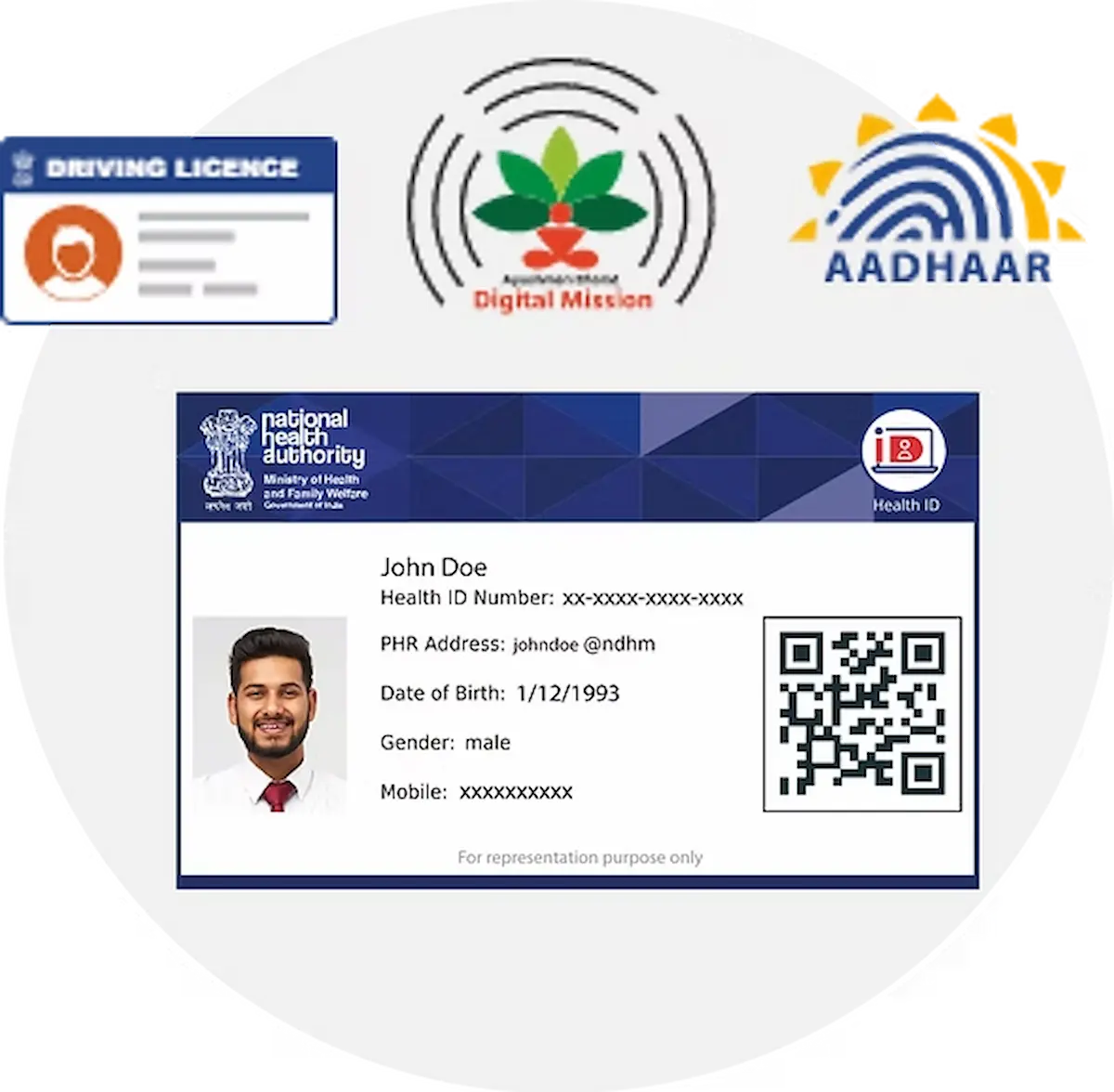
ABHA is not just a health card. It is a unique 14-digit digital health identity that allows individuals to securely link, access, and share their health records across the healthcare ecosystem — with their explicit, revocable consent. It is the foundational layer of the Ayushman Bharat Digital Mission (ABDM), India's ambitious plan to build a national digital health infrastructure that spans public and private providers, insurers, labs, and pharmacies.
The best analogy is Aadhaar for health — but with one crucial architectural difference: consent. Aadhaar is a government-issued identity used for authentication. ABHA gives you direct control over your own health data. No one — not the hospital, not the insurer, not the government — can access your records without your explicit, revocable consent. The consent manager is not a policy add-on. It is the core architectural mechanism through which the system operates.
Launched in September 2021, ABDM is implemented by the National Health Authority (NHA) under the Ministry of Health and Family Welfare. It is designed to provide digital health records — all your health information stored securely in one place — with portability so your records follow you across hospitals, clinics, and cities, consent-based sharing so you decide who sees your records, when, and for how long, and paperless healthcare that eliminates the need to carry files of paper to every appointment.
How ABHA Works in Practice
Creating Your ABHA Account
You can create an ABHA account in minutes through the ABHA app or any ABDM-enabled application. You need your Aadhaar number or driving licence and a mobile number linked to your Aadhaar. You also create an ABHA address — a username, like an email ID — that serves as your identifier in the digital health ecosystem. This address is what you share with healthcare providers, not your Aadhaar number.
Storing and Sharing Health Records
When you visit a healthcare facility that uses ABDM-enabled software, your records are linked to your ABHA account. At registration, you scan a QR code at the hospital using the ABHA app, your demographic details are securely retrieved from your ABHA account, and a digital queue token is generated — eliminating the paper registration form. If you have been treated elsewhere, you can share your previous records with the new doctor with a few clicks and your consent PIN. Your new prescriptions, lab reports, and diagnoses are automatically linked to your ABHA account.
The outcome is structurally transformative: the doctor sees your complete medical history. They know your prior diagnoses, your allergies, your medications, your test results. They do not need to repeat tests that were already done. They do not need to rely on your incomplete recollection of what happened. They can see you as a continuous patient, not an isolated episode.
The Consent Manager
This is the privacy mechanism that distinguishes ABHA from centralised health databases. Every time a healthcare provider requests access to your records, you receive a notification. You decide what records to share, with whom, and for how long — a specific doctor, for a specific purpose, for a specific duration. This consent is revocable at any time. The system is architected so that no one can access your data without your explicit approval. Not the hospital. Not the insurer. Not the government.
The Growth Story — and Its Achievements
ABHA's growth has been extraordinary. In just five years, it has become one of the world's largest digital health ecosystems — measured by accounts, records linked, and facilities onboarded.
Scale
As of July 2026, over 93.95 crore (nearly 940 million) ABHA accounts have been created, with more than 105 crore health records linked to these accounts. The year-by-year trajectory tells the story of accelerating adoption: 14.7 crore accounts in 2021, 30.4 crore in 2022, 50.6 crore in 2023, 72.2 crore in 2024, 84.5 crore in 2025, and 90 crore by May 2026.
State-Level Adoption
Uttar Pradesh leads with over 15.3 crore ABHA accounts, followed by Rajasthan and Maharashtra with 7.1 crore each, Bihar with 6.3 crore, and West Bengal with 5.9 crore. Some states have achieved remarkable saturation: Andhra Pradesh at 98.5%, Odisha at 91.9%, Rajasthan at 89.7%, Himachal Pradesh at 88.9%. Union Territories including Andaman and Nicobar Islands, Ladakh, and Lakshadweep have achieved full saturation.
Healthcare Infrastructure
The ABDM ecosystem now includes 5.33 lakh health facilities registered on the Health Facility Registry and 9.85 lakh healthcare professionals on the Healthcare Professionals Registry. Over 2.72 lakh healthcare facilities have adopted ABDM-enabled software. More than 450 public and private health technology solutions have integrated with the ecosystem — from the Non-Communicable Disease Programme and CoWIN to private hospital chains and digital health apps.
Reducing Waiting Times
The "Scan and Share" service has reduced patient waiting times at OPDs from approximately one hour to just 2 to 5 minutes, according to a study by the Indian Institute of Health Management Research. Over 23.21 crore ABHA-linked tokens have been issued at healthcare facilities. This is the kind of measurable operational improvement that drives adoption — patients use ABHA not because the government tells them to, but because it makes their hospital visit faster.
Women's Empowerment
Women account for 49.75% of all ABHA holders — nearly half. This supports continuity of care for maternal health, child healthcare, immunisation, and other essential services where fragmented records have historically produced the worst outcomes. A pregnant woman moving between her village, a district hospital, and a specialist in a city can now carry her medical history with her — and share it with each provider, on her terms.
Incentivising Digitisation
The Digital Health Incentive Scheme has channelled over ₹107 crore to hospitals, ₹2.95 crore to diagnostics labs and pharmacies, and ₹26 crore to digital solution companies — using financial incentives to accelerate adoption across a fragmented healthcare landscape where digitisation was never a priority for most small and mid-sized providers.
What ABHA Gets Right
1. Democratising Health Data
Before ABHA, health records were locked in hospital silos. The patient had no control, no access, no portability. ABHA shifts power from institutions to individuals on the principle that your health data belongs to you — not to the hospital, not to the insurer, not to the government programme that paid for your treatment. This is a structural shift in who holds power in the healthcare system.
2. Consent as Architecture, Not Policy
Privacy concerns have plagued India's earlier digital initiatives. ABHA explicitly addresses these through its consent-manager architecture. This is not a promise — it is how the system is built. No one can access your records without your explicit, revocable consent. The consent mechanism is the gate through which every data access request must pass. This is the same self-sovereign identity principle that underpins Digi Yatra's biometric architecture, applied to health data.
3. Interoperability with India Stack
ABHA uses Aadhaar for identity verification, DigiLocker for document storage, and integrates with PM-JAY — India's public health insurance scheme — enabling cashless treatment for eligible families. It also connects to CoWIN for vaccination records, Nikshay for TB management, and the Non-Communicable Disease Programme. Each layer interoperates, and the patient benefits from the integration of systems that were previously disconnected.
4. Inclusion of the Unorganised Sector
ABHA is accessible to everyone — regardless of whether they have a smartphone, feature phone, or no phone at all. Assisted registration methods ensure that even the digitally excluded can participate. This is essential because the patients who would benefit most from portable, continuous health records — migrant workers, rural women, the elderly — are precisely those least likely to have smartphones or digital literacy.
5. Global Scale
No other country has attempted to build a digital health ecosystem for 1.4 billion people — with over 105 crore health records linked, nearly 94 crore ABHA accounts, and 5.33 lakh health facilities on a single network. The NHS App in the UK serves about 30 million people. The European Health Data Space is still being built. ABHA is already operating at a scale that makes it the largest digital health identity system in the world.
The Problems Nobody Talks About
The Digital Divide
While ABHA is designed to be inclusive, it still depends on the availability of healthcare facilities with ABDM-enabled software. In remote areas, where healthcare infrastructure is already limited — sometimes a single government doctor serving a hundred villages — digitisation has not reached, and may not for years. The "Model Districts" and "Model Facilities" initiatives aim to address this, but a model district is a demonstration, not a deployment. The gap between demonstration and universal coverage is where digital health infrastructure lives or dies.
The Data Security Concern
Despite the consent-manager architecture, the concentration of health data — the most sensitive personal information a person can generate — in a digital system raises structural privacy concerns. The ABDM ecosystem stores a significant amount of personal health information. While the system is designed to be secure, data breaches are always possible, and health data breaches are more consequential than financial data breaches. You can change your credit card number. You cannot change your HIV status, your mental health diagnosis, or your genetic profile once they are exposed. The government has emphasised that data protection and security standards are maintained, but the track record of India's digital systems — including Digi Yatra's 2024 breach — is mixed.
Awareness and Confusion
Not everyone understands what ABHA is or how to use it. Many people confuse ABHA with the Ayushman Bharat PM-JAY insurance card. The distinction matters: ABHA is for managing digital health records; the Ayushman card provides health insurance coverage. A hospital announcement that "ABHA card registration and on-site printing" is now available reflects the common confusion — ABHA is not a physical card that needs to be printed. It is a digital identity. The fact that hospitals feel the need to print it suggests that the digital-first design is running ahead of both user understanding and institutional practice.
The "Voluntary but Essential" Concern
While ABHA is officially voluntary, it is becoming increasingly essential to access healthcare efficiently. Many hospitals now prefer — or steer — patients who have an ABHA account. This mirrors the pattern seen with Aadhaar: optional in theory, required in practice. When the queue for ABHA-linked patients is 5 minutes and the queue for non-ABHA patients is an hour, the "choice" becomes coercive. The consent architecture is real, but the voluntariness of participation is under quiet pressure.
Integration with Legacy Systems
While over 450 health technology solutions have integrated with ABDM, integration is uneven. Some hospitals and diagnostic labs still use legacy systems — or paper — that cannot interoperate with ABDM. Ensuring seamless integration across India's diverse healthcare landscape, from corporate hospital chains to single-doctor clinics in small towns, is a challenge that the number of integrated solutions does not fully capture. The 2.72 lakh facilities that have adopted ABDM-enabled software are impressive. The millions that have not are the gap between the platform and the patient.
ABHA in the Global Context
India is not the only country building digital health infrastructure. The European Union has its European Health Data Space — an ambitious framework for cross-border health data sharing. The United Kingdom has the NHS App, serving about 30 million people. The United States has health information exchanges that connect providers within regions, though interoperability remains a persistent challenge. Estonia's digital health system is often cited as the global benchmark — but Estonia has 1.3 million people. India has a thousand times that.
India's scale is the differentiator. No other country has attempted to create a digital health identity for over 90 crore people and link over 105 crore health records across public and private healthcare providers. The combination of digital identity (Aadhaar), health records (ABHA), and health insurance (PM-JAY) into a single interoperable stack is architecturally unique. The National Health Authority is exploring international collaborations in digital health, sharing its experience with other countries — because any country that can make digital health records work at India's scale has solved problems that smaller countries will never encounter.
The Road Ahead
ABDM's leadership is focused on several priorities as the platform matures from rapid account creation to active usage.
Deepening adoption: The next phase focuses on increasing active use of the infrastructure — not just creating accounts, but ensuring that citizens actively use ABHA to store, share, and access their health records when they interact with the healthcare system. An account that exists but is never used is a database entry, not a health record.
Expanding infrastructure: The Model Districts and Model Facilities initiatives aim to accelerate adoption across states, with the goal of ensuring ABDM-enabled facilities are available everywhere, not just in urban centres.
Integrating with more schemes: ABDM is integrating with PM-JAY, CGHS, ESIC, and Nikshay — enabling seamless health record sharing across insurance schemes and disease programmes.
Leveraging AI: The ABDM Mission Steering Group discussed expanding AI use for anonymised health data analysis — disease surveillance, diagnostics, and healthcare planning. The AI-driven health insights feature in Aarogya Setu 2.0, launched in June 2026, is an early step.
Recommended tools & resources
If you want to explore digital health, health data, and healthcare infrastructure deeper, these resources can help.
Disclosure: Links may be affiliate links. See Disclaimer.
The Verdict
ABHA is neither the perfect solution its supporters claim nor the privacy risk its critics suggest. It is an infrastructure project at extraordinary scale — nearly 94 crore accounts, 105 crore health records linked, 5.33 lakh facilities registered — but still in the transition from account creation to active, meaningful usage. The architecture is built. Whether it changes how healthcare is delivered depends on whether the millions of healthcare interactions that happen every day in India flow through it.
The direction is right. An India where every citizen has a digital health identity, where medical records follow them across the country rather than being trapped in institutional silos, where consent is the foundation of data sharing rather than an afterthought, and where healthcare delivery is more efficient and patient-centric — this would be a more equitable and healthier nation. The numbers are real. The consent architecture is real. The interoperability with Aadhaar, DigiLocker, and PM-JAY is real.
But the challenges are also real. The digital divide means the patients who would benefit most from portable health records are the least likely to have access to ABDM-enabled facilities. The concentration of health data creates privacy risks that financial data breaches do not. Awareness and confusion persist — many users do not know what ABHA is or how it differs from their insurance card. The voluntary-but-essential creep is underway. And the millions of healthcare facilities that have not yet adopted ABDM-enabled software represent the gap between the platform's potential and its current reach.
The old health records system — paper files, institutional silos, fragmented care — had decades to entrench itself, and the institutions that hold patient data have every incentive to keep it. ABHA deserves more than five years to prove its case. But it will only earn that time if it moves from 94 crore accounts to 94 crore active users — people who use ABHA not because a hospital asked them to register, but because it makes their healthcare better, faster, and safer. The architecture is built. The test now is whether it reaches every patient, in every clinic, in every village — and whether they trust it with the most personal data they have.